800-522-3725
 info@standleys.com
 Support
14 min read

Nearly 30% of desk workers lose an hour or more of productivity to everyday tech issues each week, a new survey from Standley Systems reveals.
--
Office technology is intended to support the workday without drawing attention to itself. Workers expect to open their laptops, access files, join meetings, print documents, and move from task to task without having to think about the tools in front of them. When those systems function as intended, work moves forward seamlessly; when they do not, even minor setbacks begin to drain time, focus, and output.
Office technology refers to the computers, networks, printers, and software systems employees rely on to perform everyday work tasks. When those systems operate reliably, work moves smoothly. When they fail, even small delays can interrupt concentration and slow productivity.
That is what makes everyday tech issues so costly. The problem is rarely a single major outage. More often, it is a slow computer, an inconvenient restart, a dropped connection, a stalled print job, or a support process that feels harder than troubleshooting the issue alone. Over time, those interruptions create a workday shaped by waiting, rework, and broken concentration. In many offices, that drag has become common enough to feel normal, even when it is quietly reducing productivity.
To better understand the impact of everyday office technology issues, Standley Systems—a provider of managed print services, document management, and other workplace technology solutions in Oklahoma and North Texas—partnered with Pollfish on the 2026 Standley Systems Office Technology Report: How Workplace Slowdowns Affect Productivity. The survey of 500 desk-based workers examines how often employees encounter technology slowdowns, which issues consume the most time, and how those interruptions disrupt the workday.
Key Findings
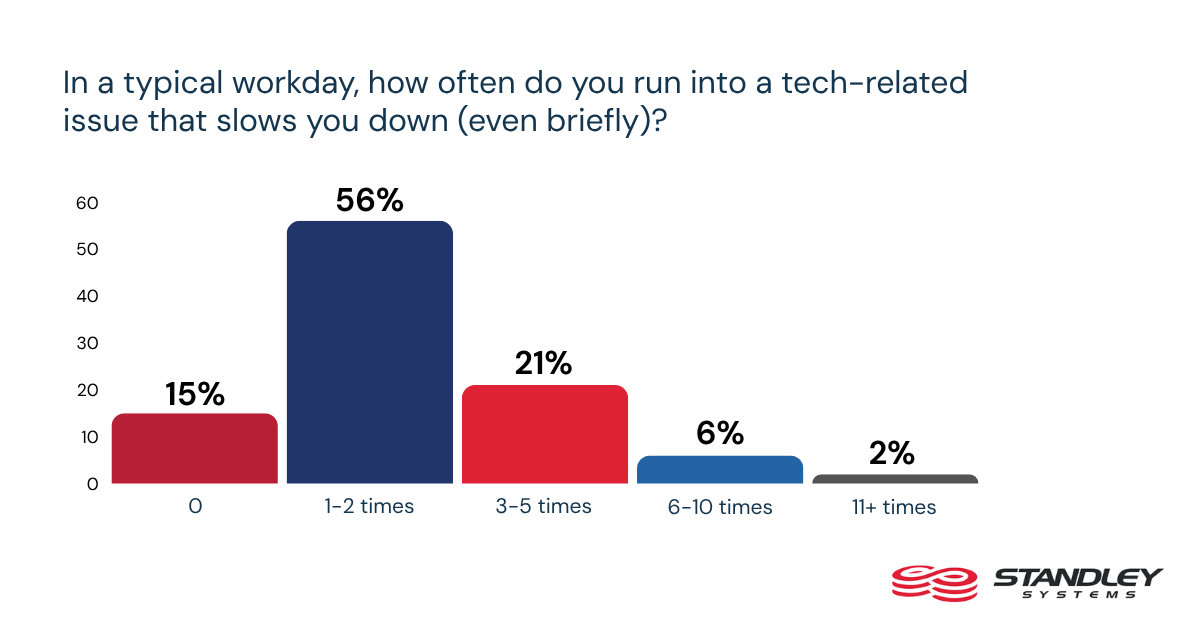
- 85% of desk workers say they run into a tech-related slowdown at least once per workday, including 29% who face them three or more times a day.
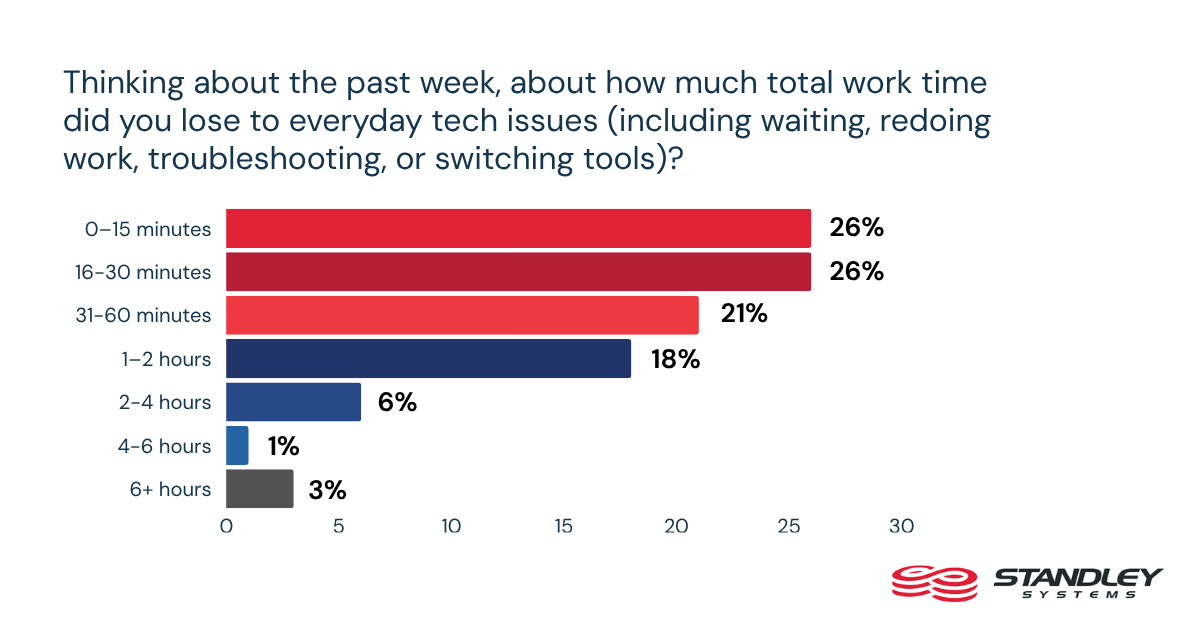
- Nearly half of desk workers lose more than half an hour to everyday tech issues each week, and nearly 30% lose an hour or more.
- Only 30% say they regain focus immediately after a tech interruption, while another 30% say it takes at least six minutes to fully get back on track.
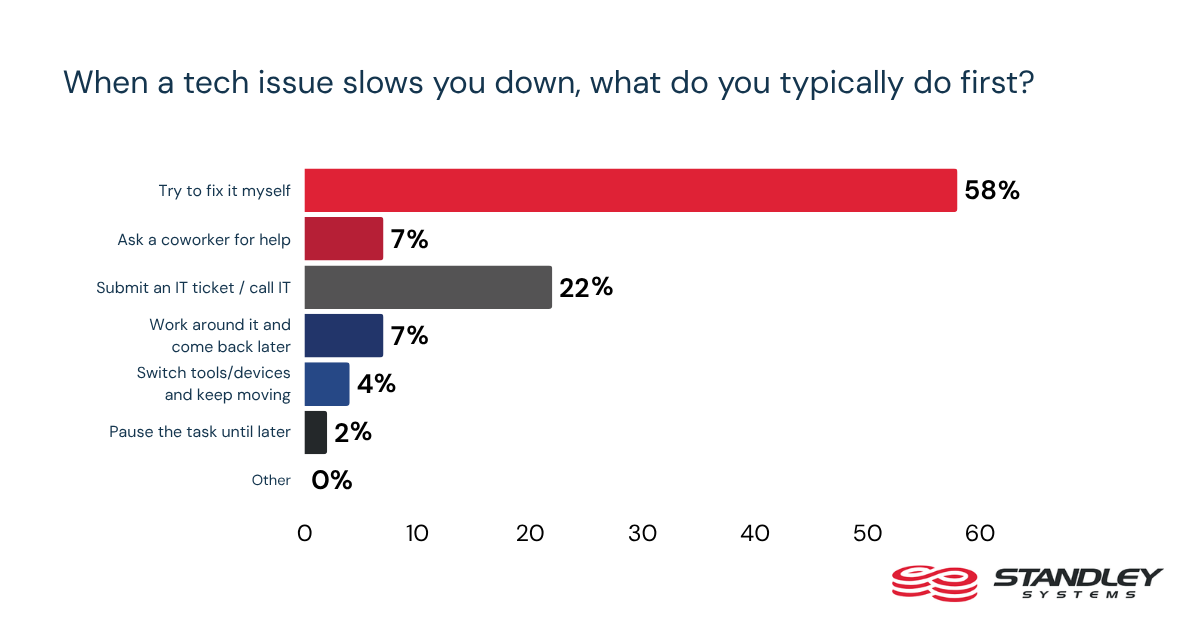
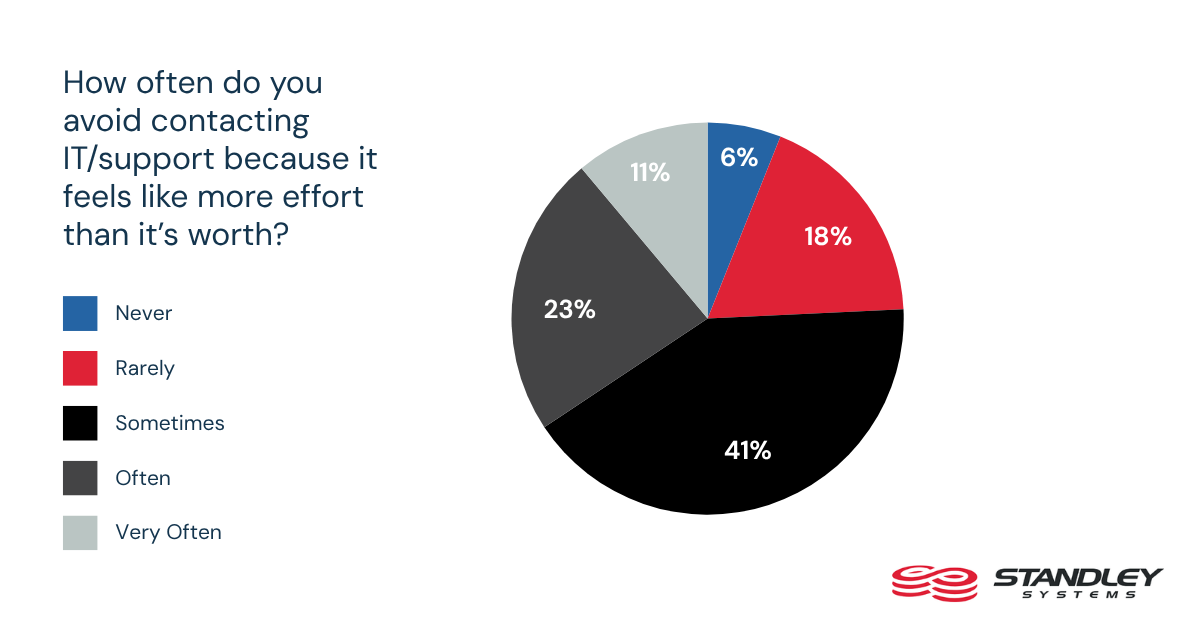
- 58% say their first response to a tech issue is to try fixing it themselves, and 76% say they avoid contacting IT at least sometimes because it feels like more effort than it is worth.
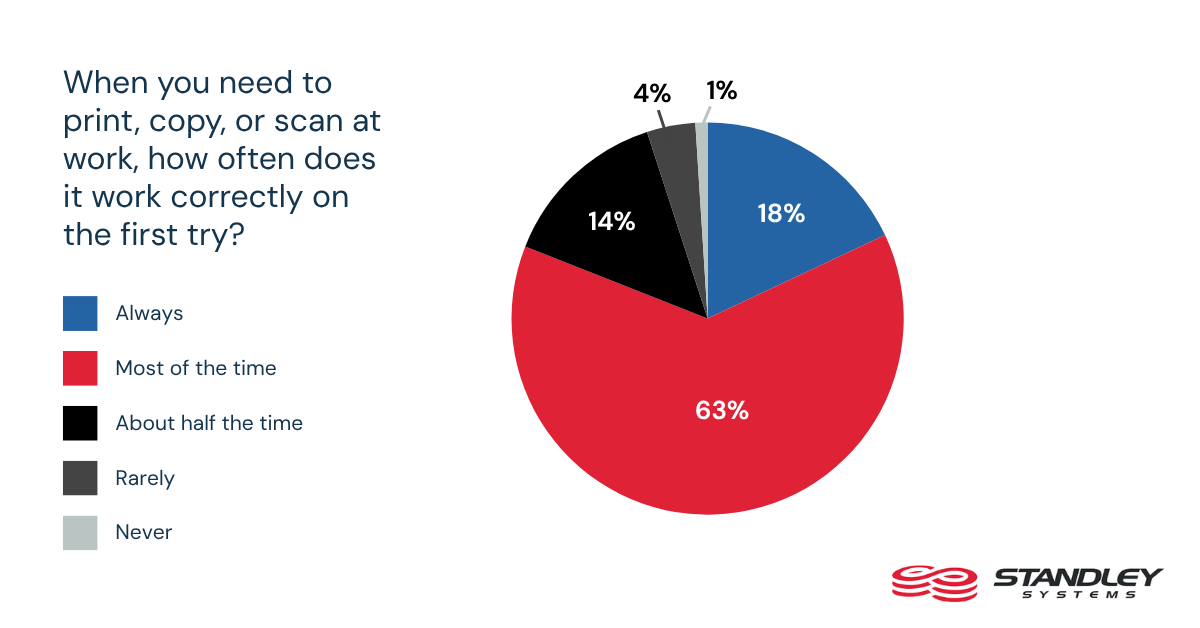
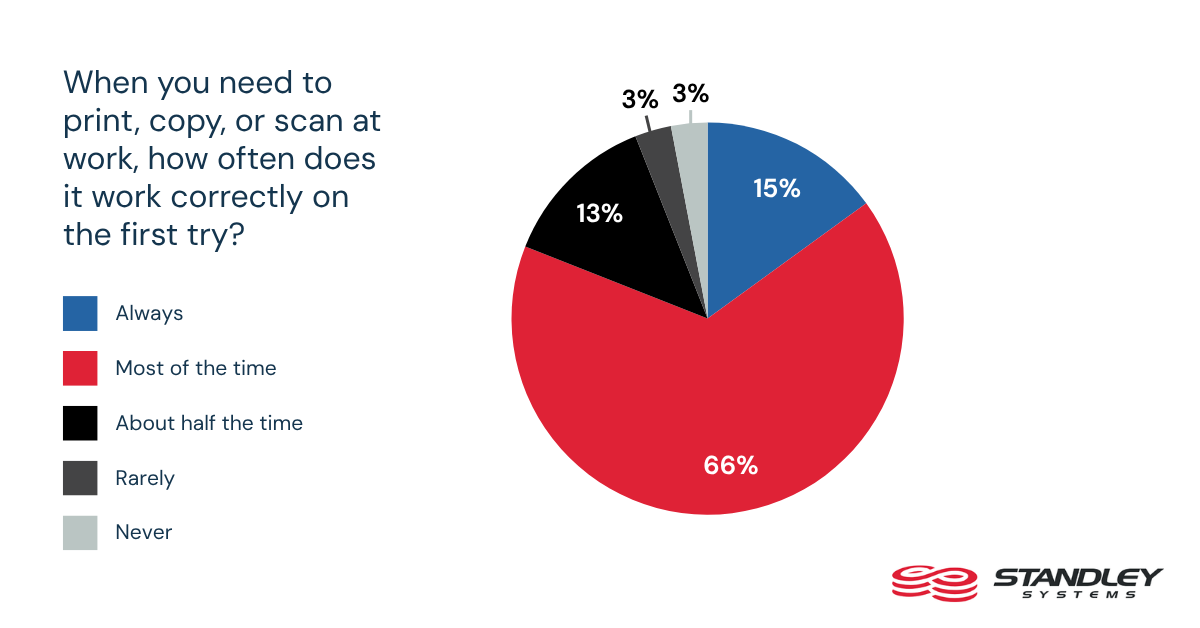
- Only 18% say printing, copying, or scanning always works correctly on the first try.
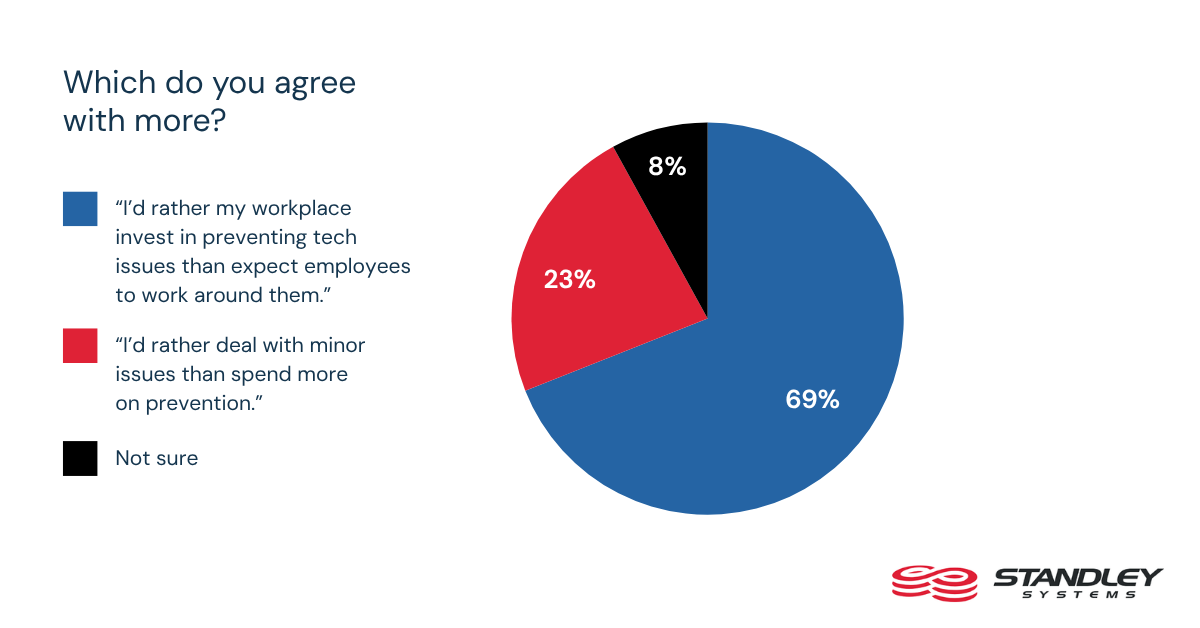
- 69% say they would rather their workplace invest in preventing tech issues than expect employees to work around them.
These findings from the 2026 Standley Systems Office Technology Report show that routine tech slowdowns are not minor inconveniences on the edge of the workday. They are recurring interruptions that consume time, break focus, and push employees toward self-troubleshooting and workaround behavior instead of fast, reliable resolution.
“Employees should not have to build their workday around unreliable technology,” said Greg Elliott, CEO, Standley Systems. “This survey suggests many have simply learned to absorb those interruptions as part of the job, even when they are clearly costing time and focus. That should prompt organizations to look more closely at whether the tools people rely on every day are truly supporting productive work.”
Everyday Office Technology Slowdowns Are Taking a Daily Toll
For many workers, office technology issues are not rare disruptions. They are recurring parts of the workday that chip away at time and momentum. The survey shows these slowdowns are frequent enough to shape how work gets done, from the time employees lose each week to the tools and systems that create the most drag. It also shows that some of the most familiar office tasks, including printing and copying, remain less reliable than many workplaces may assume. Together, these findings point to a simple reality: routine tech slowdowns are becoming a regular productivity problem.
Tech slowdowns are part of the daily routine.
Rather than appearing as occasional setbacks, these issues show up as routine interruptions in the flow of work. Nearly 85% of desk workers say they run into a tech-related issue that slows them down at least once per workday, including 56% who say it happens 1 to 2 times a day and 29% who say it happens 3 or more times. For most workers, these interruptions are no longer exceptions. They are built into the rhythm of the workday.
The time loss adds up quickly.
That frequency translates into meaningful lost time. Nearly half of workers, 49%, say they lose more than half an hour to everyday tech issues in a typical week, and 28% lose an hour or more. Those slowdowns may seem small in isolation, but for a substantial share of workers they are consuming enough time each week to become a real productivity problem.
Slow computers and restart delays waste the most time.
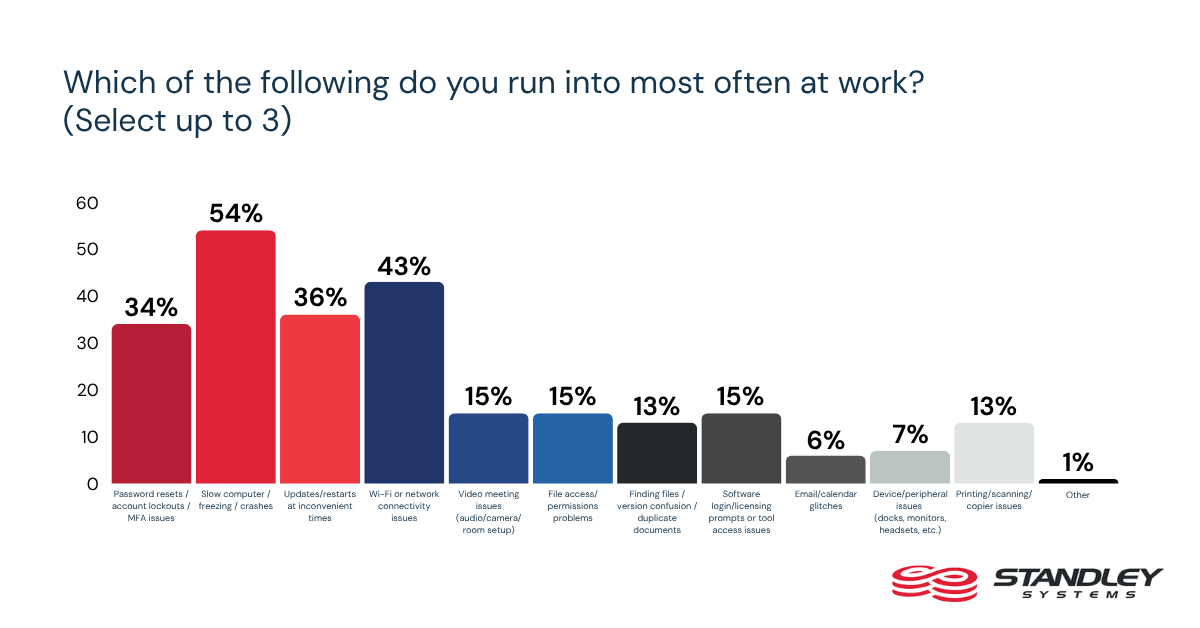
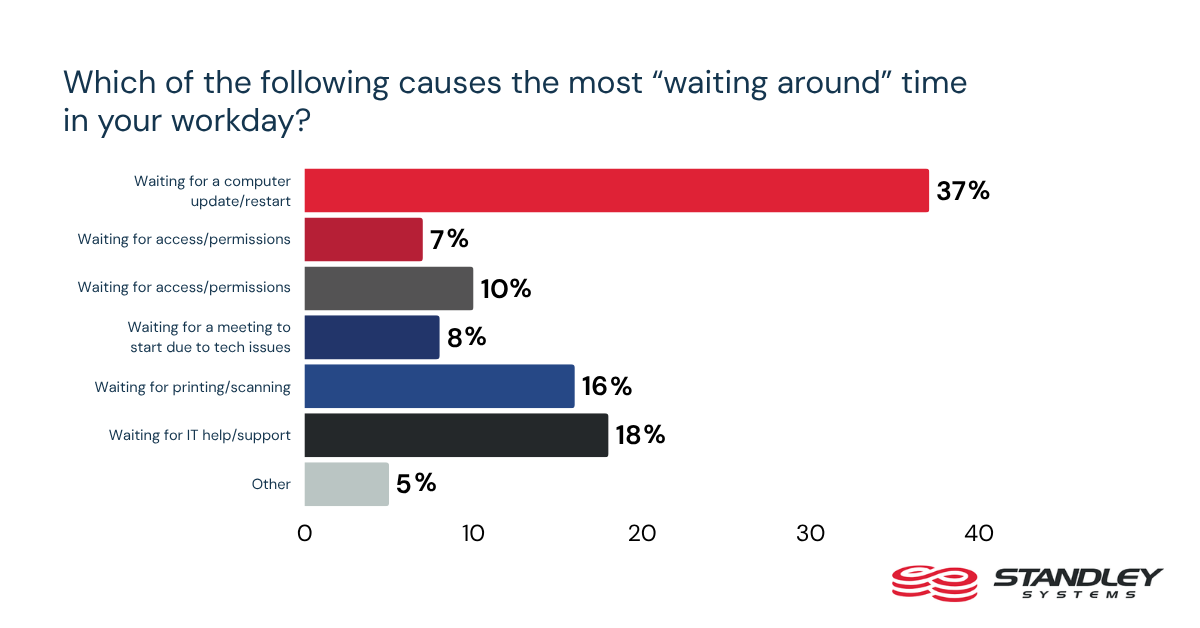
The biggest sources of drag are familiar ones. Slow computers, freezing, and crashes top the list at 54%, followed by Wi-Fi or network connectivity issues at 43%, and updates or restarts at inconvenient times at 36%. Slow computers also rank as the single biggest time-waster overall at 27%, while updates and restarts lead the list of waiting-around time at 40%. These are everyday performance problems that shape how smoothly work gets done.
Printing and copying remain part of the disruption.
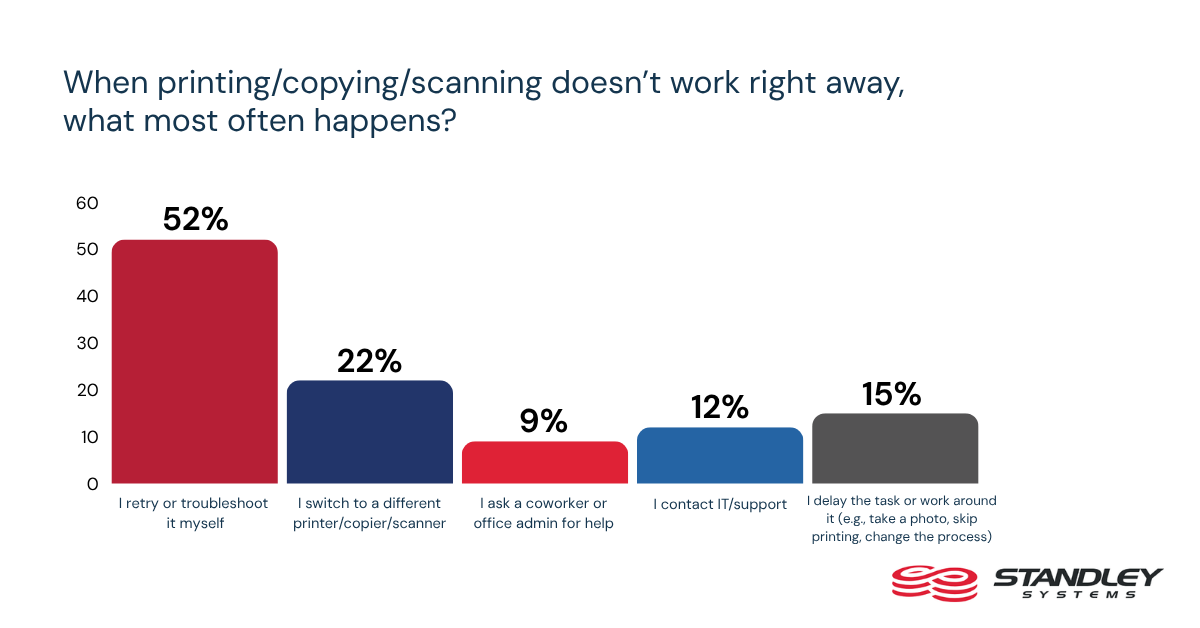
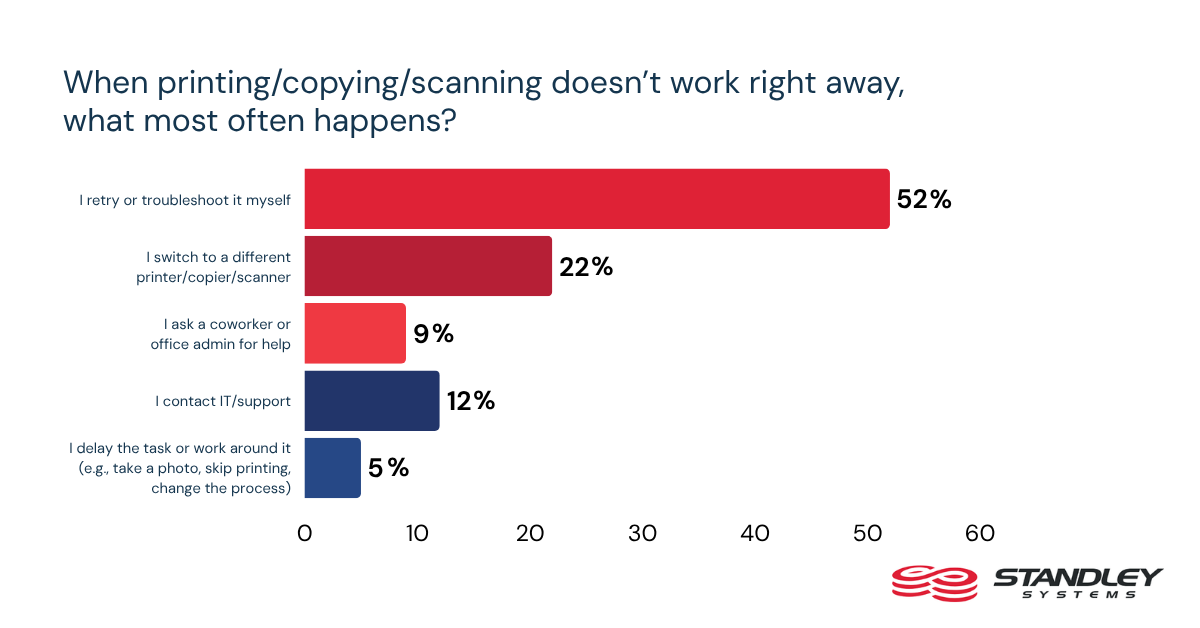
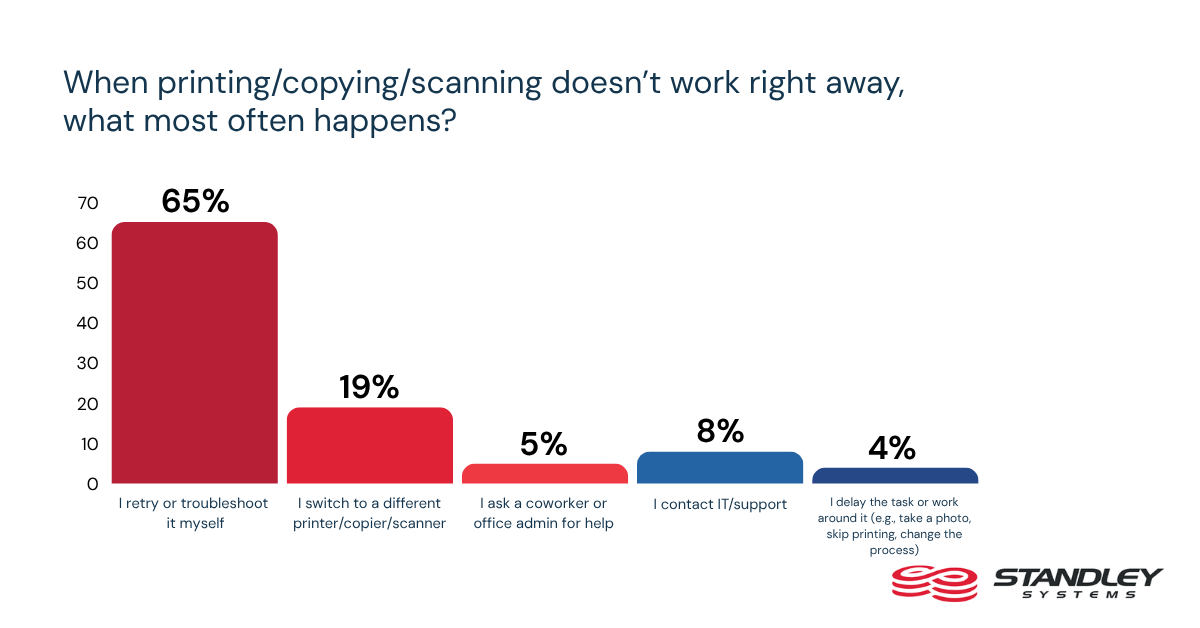
Printing, copying, and scanning are basic office tasks, but reliability is far from a given. Only 18% of workers say printing, copying, or scanning always works correctly on the first try. When those tasks fail, 52% say they retry or troubleshoot the issue themselves, while 22% switch to another device. That suggests print and copy problems continue to create avoidable disruption in the flow of everyday work.
The Cost Continues After the Problem Is Fixed
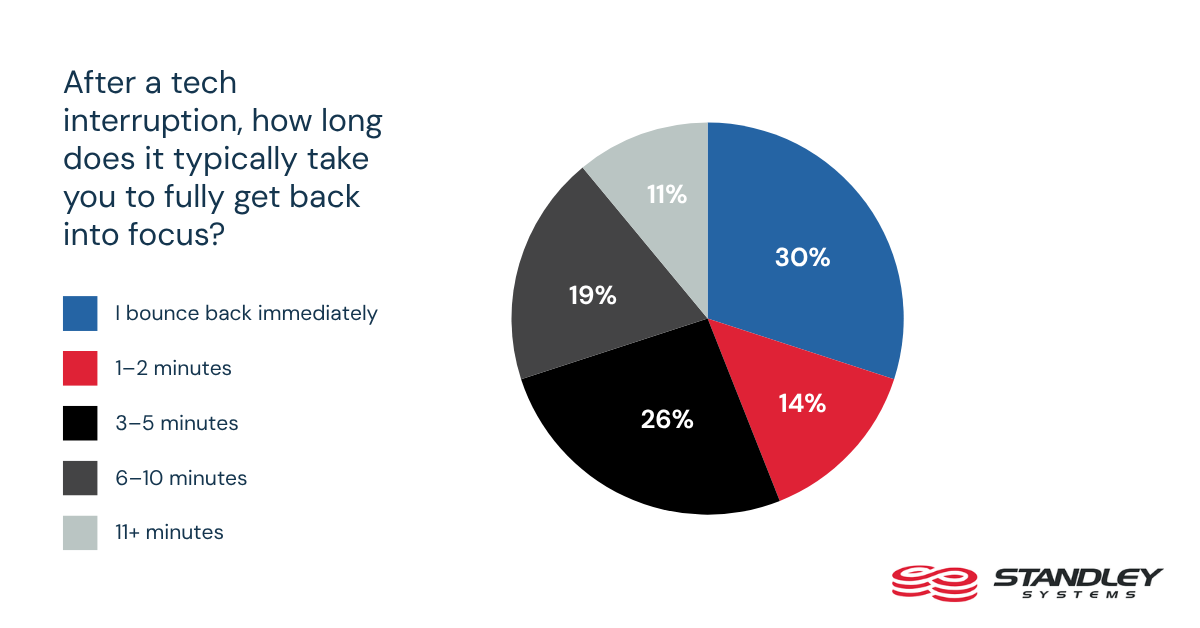
The time spent resolving a problem is only part of the productivity loss. Tech interruptions also make it harder for workers to return to the task they were doing before the glitch. Only 30% say they regain focus immediately after a tech interruption, while another 30% say it takes at least six minutes to fully get back on track. Even after the issue is fixed, many workers are still trying to recover their momentum.
That lingering effect shows up in how workers describe the hidden cost of everyday tech issues. When asked what those costs look like, 29% point to delayed work and missed deadlines, 27% cite lost focus and mental fatigue from constant interruptions, and 20% cite more mistakes and rework. The bigger problem is not always the disruption itself, but the way it continues to affect the quality and pace of work afterward.
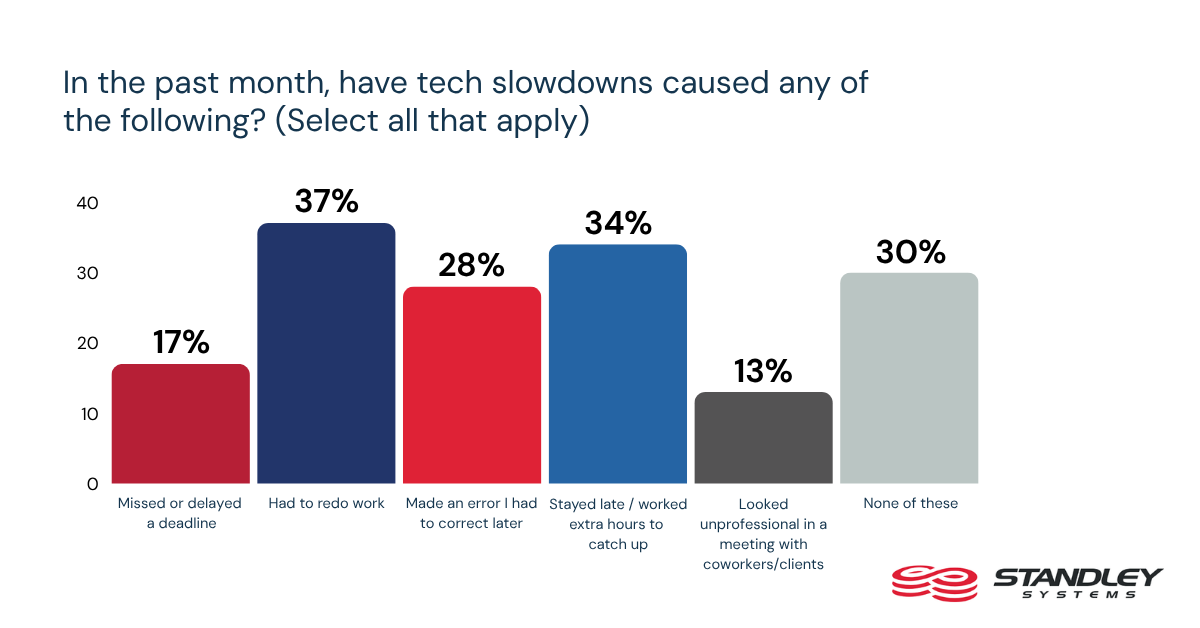
Those disruptions also carry practical consequences for the work itself. In the past month, 37% say tech slowdowns forced them to redo work, 34% say they stayed late or worked extra hours to catch up, 28% say they made an error they had to correct later, and 17% say they missed or delayed a deadline. Routine office disruption is affecting not only speed, but also work quality and schedule control.
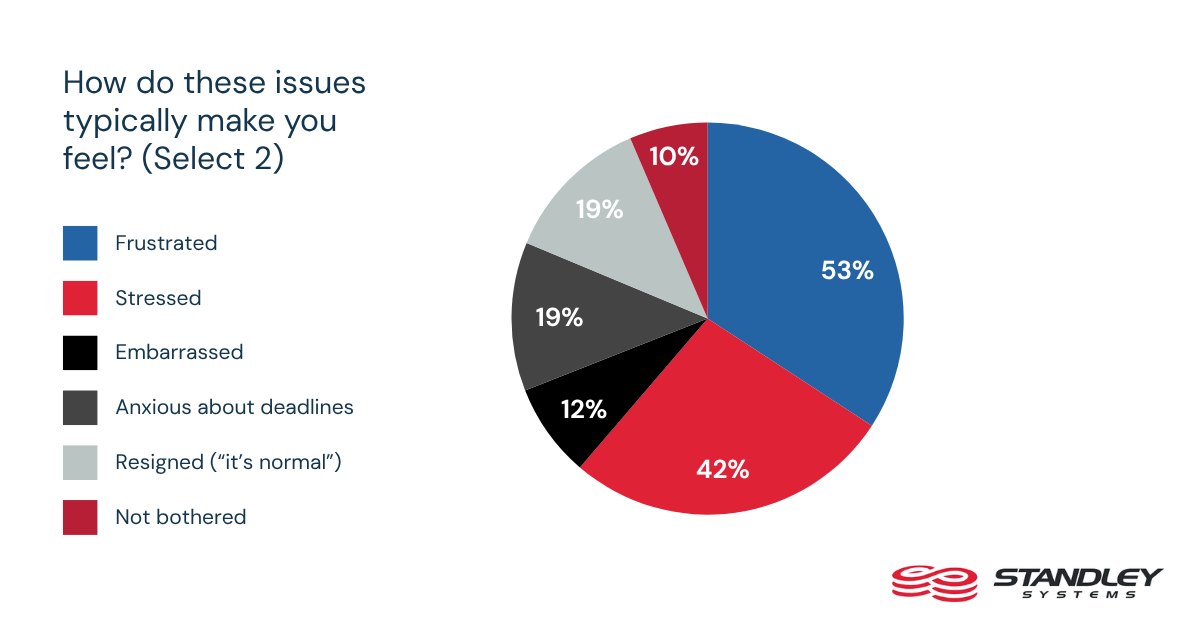
The effect reaches beyond the work itself. More than half of workers, 53%, say these issues leave them frustrated, while 42% say they feel stressed. Repeated interruptions may be easy to dismiss as part of modern work, but they are also shaping how employees experience the workday itself.
Employees Are Adapting by Troubleshooting It Themselves
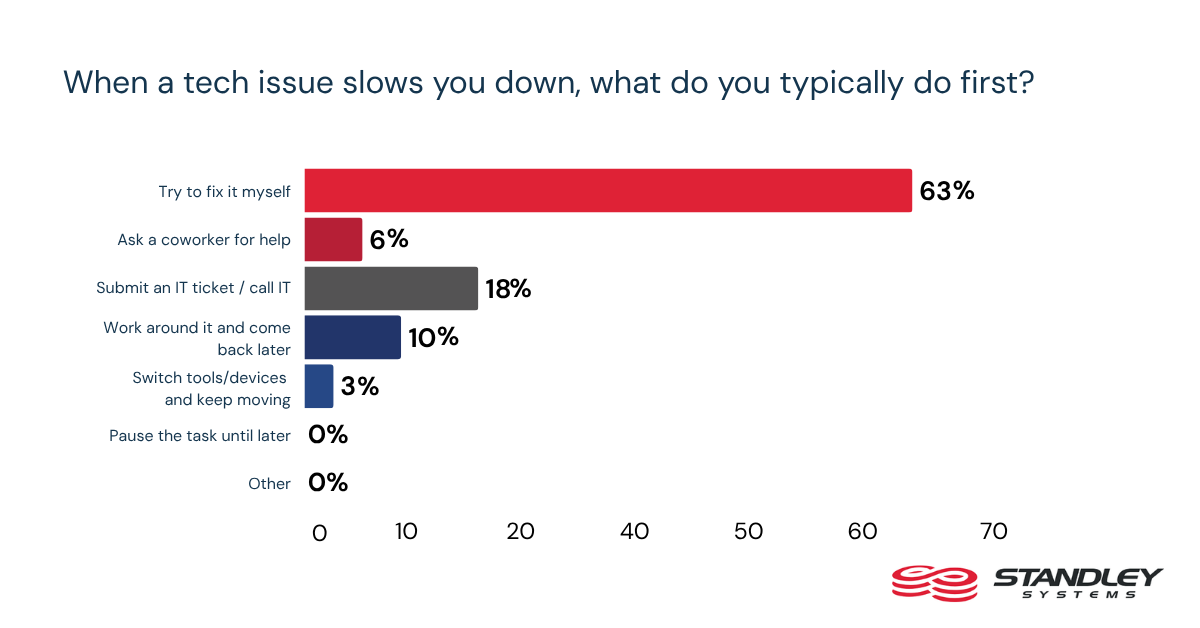
One of the clearest patterns in the survey is how often employees choose self-repair over formal support. When a tech issue slows them down, 58% say their first move is to try fixing it themselves. Only 22% say they submit an IT ticket or call IT first. For many workers, the fastest path forward appears to be handling the problem on their own.
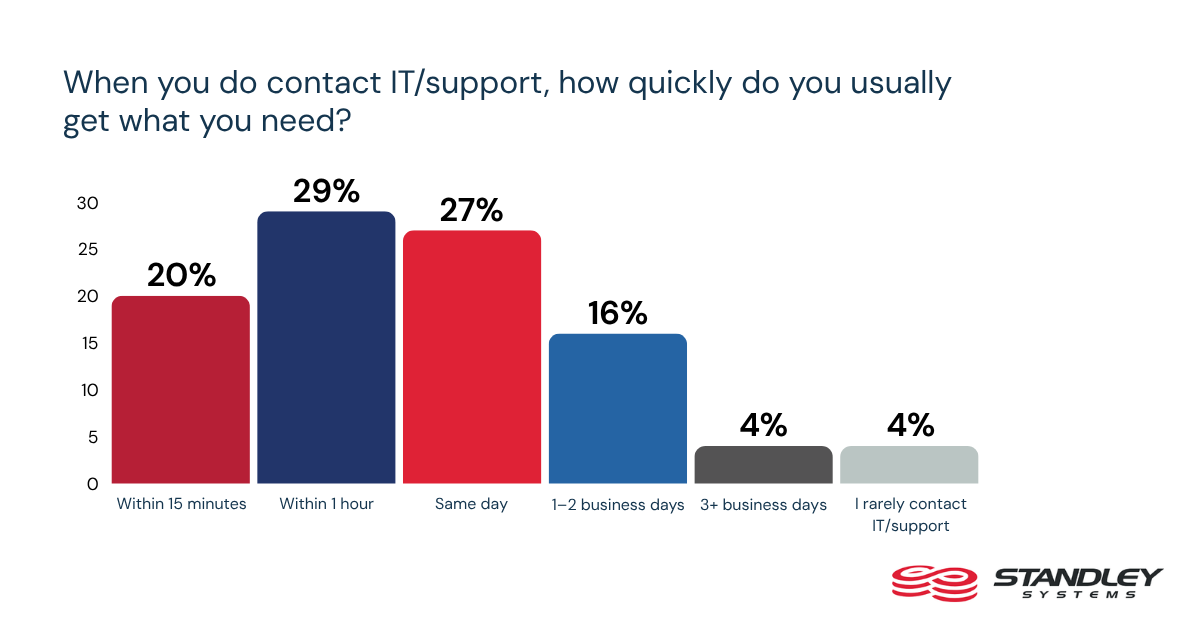
That instinct is reinforced by how workers view support itself. About 76% say they avoid contacting IT at least sometimes because it feels like more effort than it is worth. When they do reach out, response times are mixed. About 20% say they usually get what they need within 15 minutes, 29% say within an hour, and 27% say the same day. Those numbers are not catastrophic, but they suggest enough friction in the support process to push many workers toward workaround behavior.
Printing and copying reflect that same pattern. When print, copy, or scan tasks do not work right away, most employees do not escalate the issue. They retry, troubleshoot, switch devices, or adjust the task. As a result, some of the disruption tied to these everyday office tools may remain largely invisible to decision-makers, absorbed by workers in small increments rather than surfacing as formal support problems.
Workers Want Prevention More Than Workarounds
The Standley Systems survey makes clear that employees are not simply resigned to this level of disruption. Most would prefer workplaces that prevent routine tech issues rather than expecting workers to adapt around them. In fact, 69% say they would rather their workplace invest in preventing tech issues than expect employees to work around them.
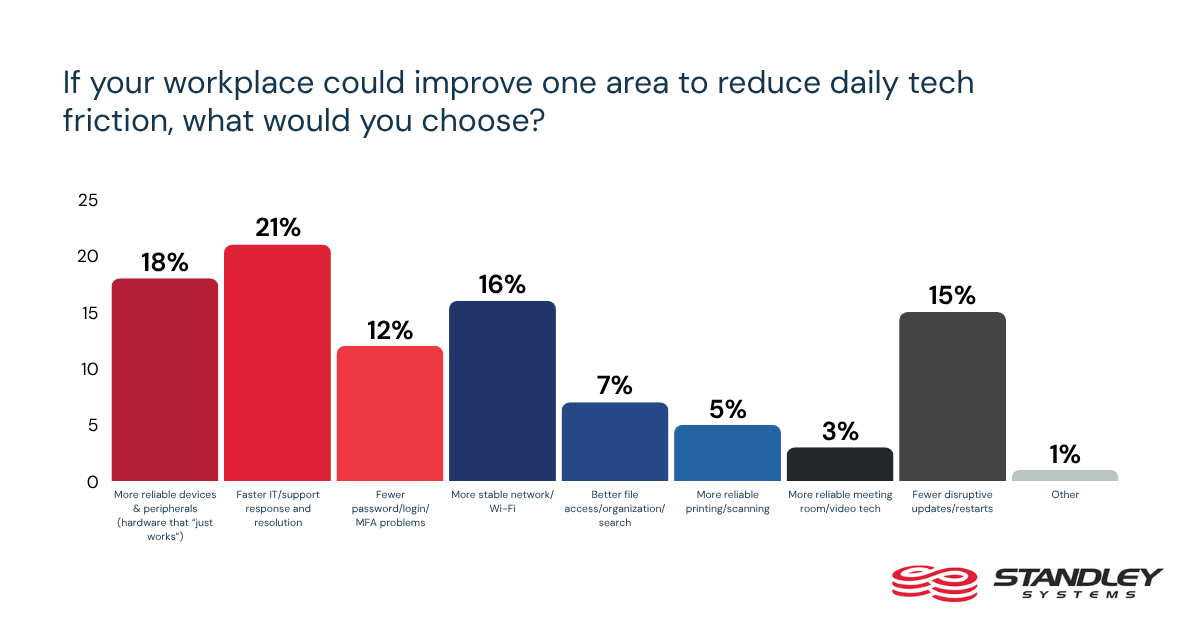
Asked what one improvement would most reduce daily tech slowdowns, workers put faster IT and support response first at 21%. That is followed by more reliable devices and peripherals at 18%, more stable network and Wi-Fi at 16%, and fewer disruptive updates and restarts at 15%.
Taken together, those responses suggest employees are looking for a work environment built around reliability rather than workarounds.In offices where people are expected to move quickly, stay responsive, and recover from interruptions without losing momentum, even small failures in routine systems can carry an outsized cost. More reliable technology is not simply an operational preference. It is increasingly a productivity baseline.
Decision-Makers May Not Fully See the Daily Impact of Office Technology Issues
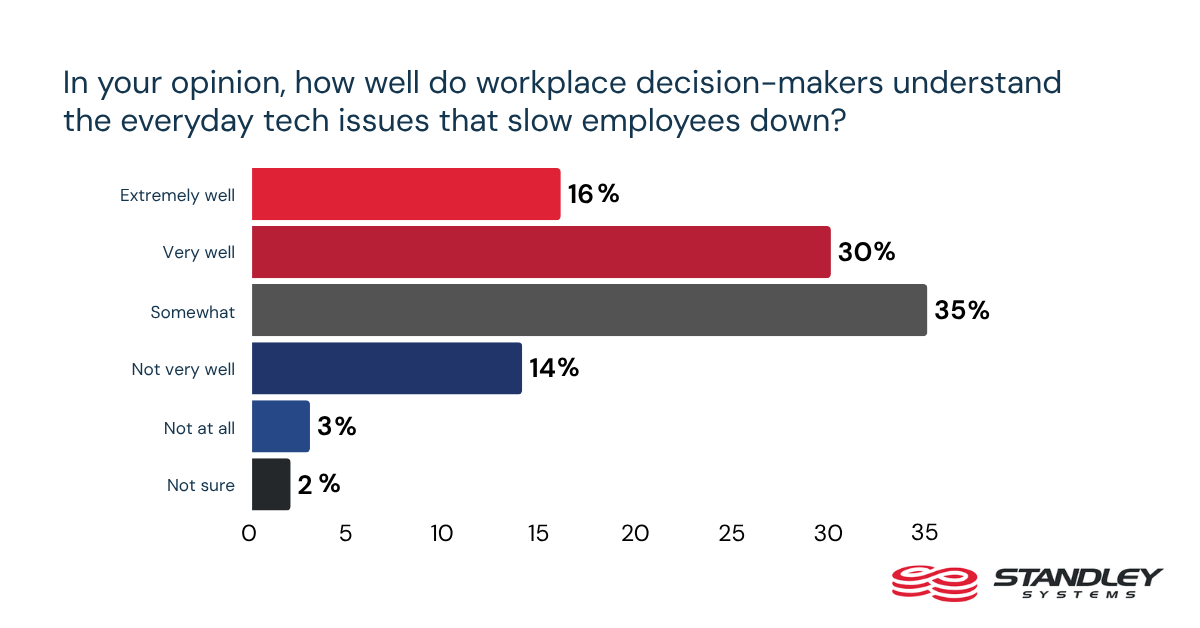
Routine technology problems shape the workday in ways that may not always be visible beyond the employee experience. Many workers do not believe workplace decision-makers have a full understanding of the everyday tech issues that slow them down. Only 16% say decision-makers understand these issues extremely well. Another 30% say they understand them very well, but the largest share, 35%, say that understanding is only somewhat strong. Nearly 1 in 5 say decision-makers understand these problems not very well or not at all.
This disconnect helps explain why so many workers appear to adapt around these problems instead of expecting them to be prevented. In offices where employees are repeatedly troubleshooting on their own or working around unreliable systems, the burden of keeping work moving can quietly shift away from the organization and onto the individual. That makes visibility an important part of the solution. The more clearly decision-makers understand the day-to-day cost of routine tech issues, the easier it becomes to treat reliability as a business priority rather than an employee inconvenience.
Nearly 60% of Dallas Workers Report Higher Stress, Frustration From Tech Slowdowns
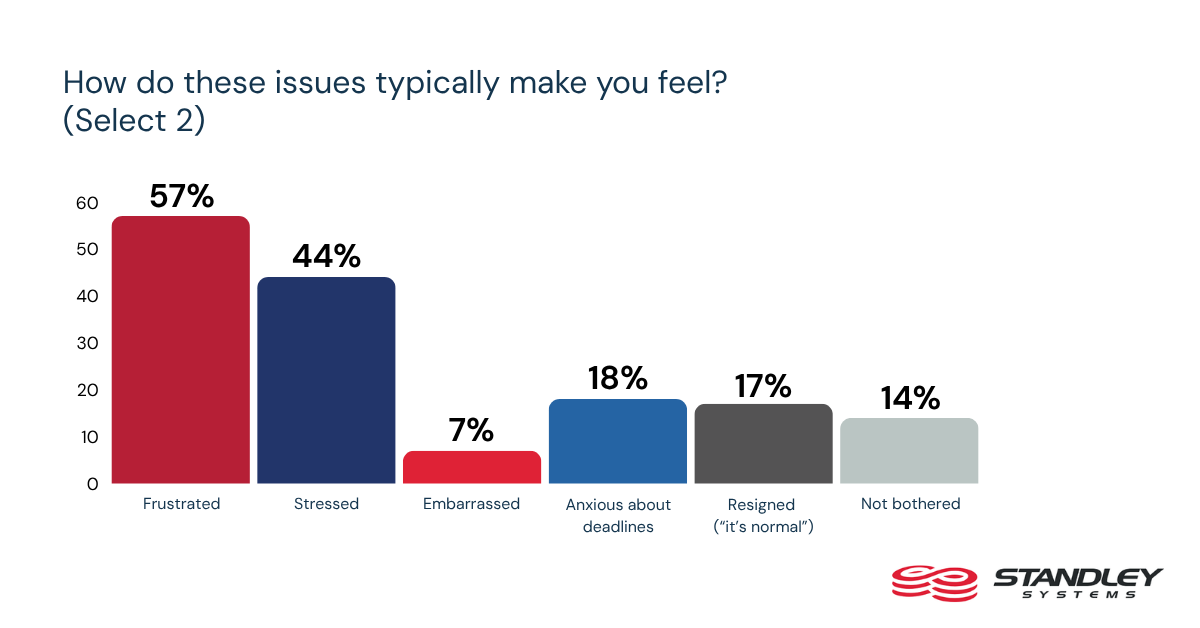
Dallas workers broadly mirror the same workplace technology story seen elsewhere, but the strain appears somewhat sharper locally. About 57% say tech issues leave them frustrated, compared with 53% overall, while 44% say they feel stressed, versus 42% overall. That sharper emotional toll shows up alongside weaker confidence in some of the routine office tools workers rely on most. Only 14% of Dallas workers say printing, copying, or scanning always works correctly on the first try, compared with 18% overall, suggesting that even basic office tasks may be contributing to the sense of daily disruption.
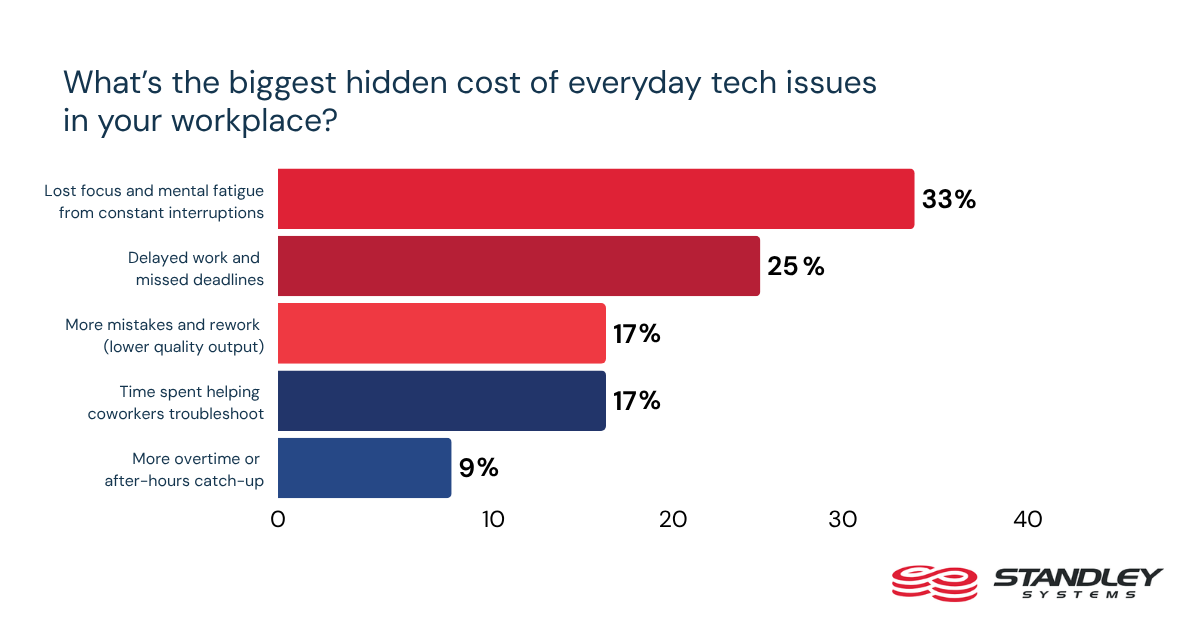
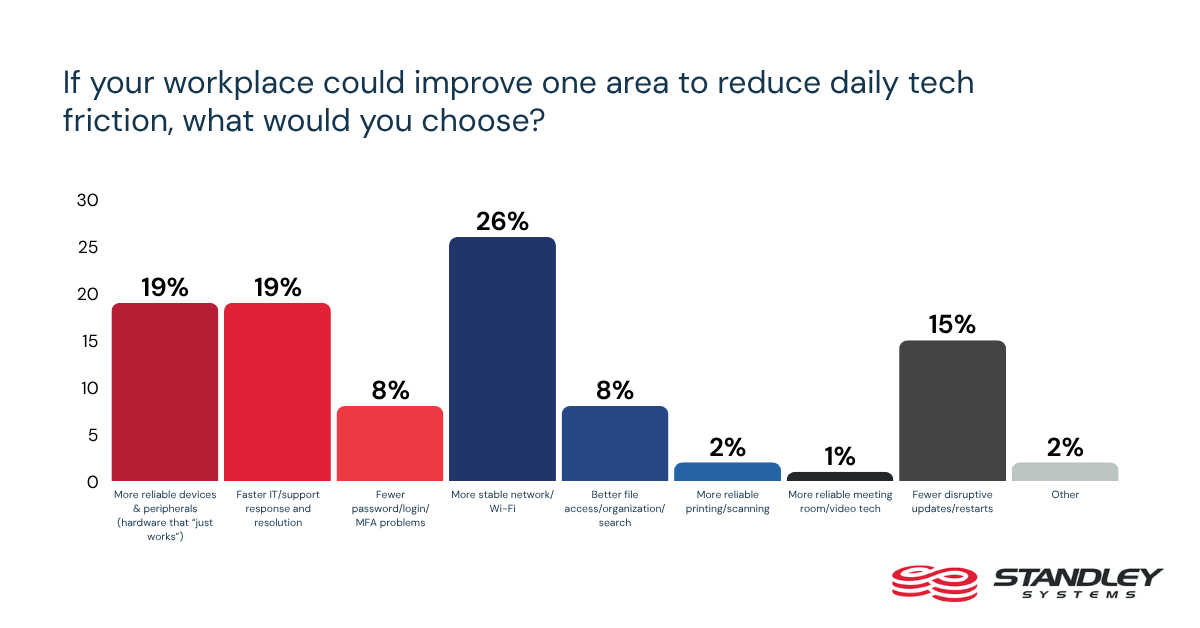
That strain also shows up in how Dallas workers describe the hidden cost of these slowdowns. In Dallas, 33% point to lost focus and mental fatigue as the biggest hidden cost, compared with 27% overall. Workers there also place more emphasis on connectivity. About 26% say more stable network and Wi-Fi performance would most reduce daily tech slowdowns, ahead of both faster IT and support response and more reliable devices and peripherals, which each coming in at 19%. Together, those numbers suggest a local work environment where recurring issues may be felt not only in lost time, but in the pressure they place on concentration throughout the day.
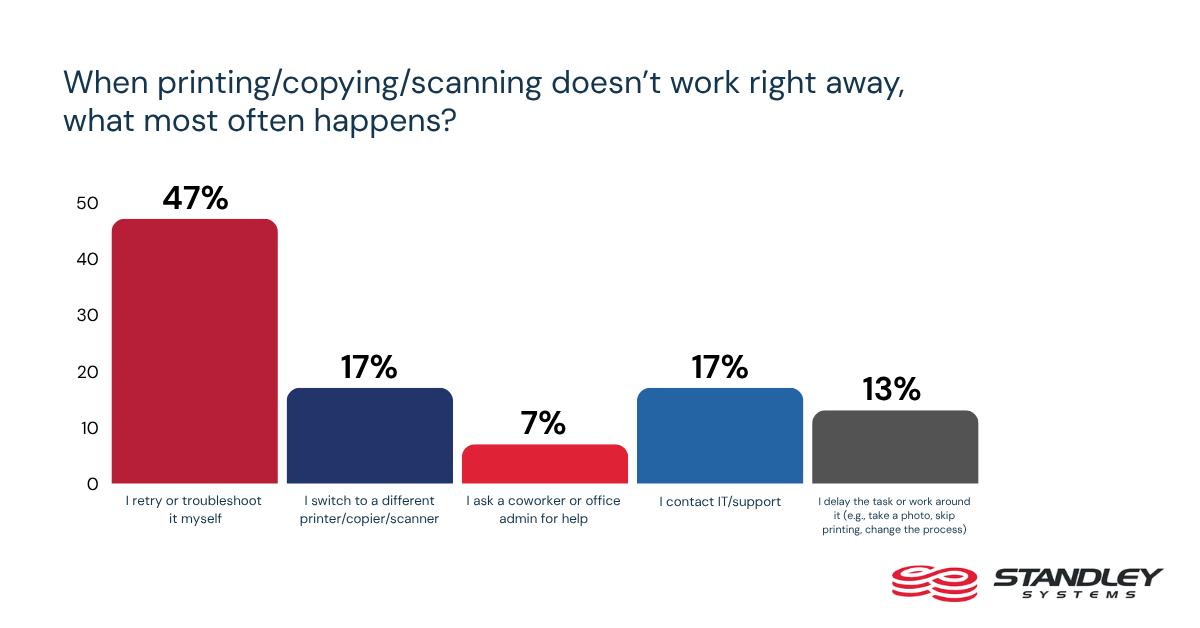
When print, copy, or scan tasks do not work as expected, Dallas workers are most likely to absorb the problem themselves. About 47% say they retry or troubleshoot the issue on their own, 17% contact IT or support, and 13% delay the task or work around it. That makes weaker print reliability more than a side issue. In Dallas, it fits into a broader pattern in which routine technology problems create daily strain and force employees to manage around them in real time.
Only 15% of Oklahoma Workers Say Printing, Copying, or Scanning Always Work on the First Try
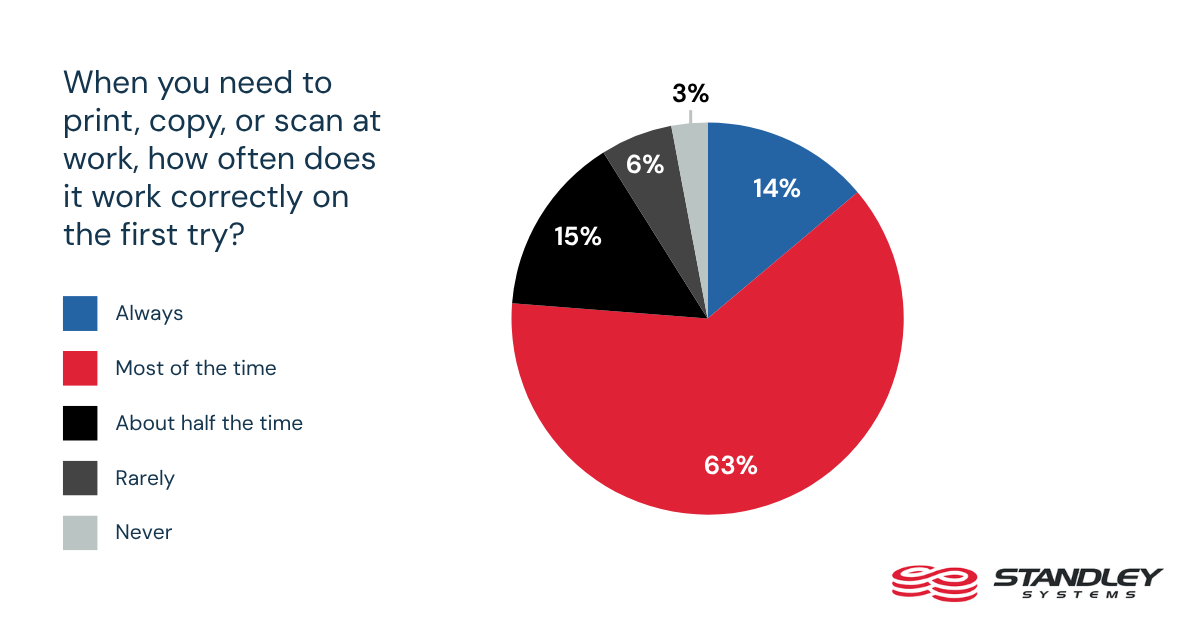
Oklahoma workers report somewhat less day-to-day technology disruption overall, but print, copy, and scan reliability still stands out as a meaningful problem. Only 15% say those tasks always work correctly on the first try, compared with 18% overall. That is a notable weak point in a state cut where several other measures appear somewhat lighter than the broader sample, making print reliability one of the clearest areas where routine office technology is still getting in the way of work.
The print and scan experience in Oklahoma also appears more likely to create passive downtime. About 16% say waiting for printing or scanning creates the most waiting-around time in the workday, compared with 7% overall. And when those tasks fail, 64% say they retry or troubleshoot the issue themselves, versus 52% overall. That suggests workers in Oklahoma are not just dealing with print and scan problems. They are spending their own time trying to push through them rather than escalating the issue.
That pattern fits a broader tendency toward self-reliance in Oklahoma. About 63% say their first move when a tech issue slows them down is to try fixing it themselves, compared with 58% overall, while only 18% say they submit an IT ticket or call IT first. Even in a local cut where the broader burden of tech issues appears somewhat lighter, printing, copying, and scanning still stand out as routine tasks that are less dependable than they should be and more likely to turn into employee-managed delays.
Conclusion
Everyday office technology issues are showing up repeatedly in the workday, draining time, breaking concentration, and pushing workers to compensate on their own. For many employees, the burden is no longer just the occasional delay. It is the cumulative effect of repeated interruptions that feel small in the moment but significant over time.
That includes the everyday office tools workers are expected to rely on without much thought. Slow computers and forced restarts remain major sources of drag, but routine print, copy, and scan tasks also continue to introduce disruption that employees often absorb quietly. When fewer than 1 in 5 workers say those tasks always work on the first try, printer and copier reliability becomes harder to dismiss as a minor issue. It is part of the larger story of how office technology either supports momentum or interrupts it.
Said Standley CEO Elliott: “Reliable technology does more than keep work moving — it gives employees the consistency they need to stay focused, responsive, and productive. That's why more companies nationwide are turning to managed print services and managed IT services from providers they can trust.”
For employers, the opportunity is to reduce how often workers run into avoidable slowdowns. Organizations that do that well may recover more than lost minutes. They may also recover focus, reduce rework, and create a work environment where employees can spend more of the day doing their jobs instead of managing around the tools meant to help them.
Methodology
To understand how routine office technology problems affect day-to-day productivity, Standley partnered with the third-party survey platform Pollfish on the 2026 Standley Systems Office Technology Report, surveying 500 desk-based workers on February 28, 2026, including 115 based in Dallas-Fort Worth and 100 based in Oklahoma. Results are presented as percentages of respondents. Some questions allowed more than one answer, so totals may exceed 100%.